Mara Haseltine leans over the side of the boat as she lowers the weighted net into the Seine. Haseltine is fishing for plankton, aquatic creatures unable to move themselves through the water. Plankton drift, eating what drifts by them and being eaten by what moves around them. Some plankton are large, such as jellies, but most require a magnifying glass or a microscope to see them.
Haseltine fishes from the 110-foot research schooner Tara. Tara was the vessel for an international effort which sampled and catalogued the oceans from 2009 to 2013, attempting to learn more about Earth’s largest biome––and the one humanity understands the least––through its populations of plankton, including everything from viruses to zooplankton. Research results from its journey won the cover spot as well as interior ink in a recent issue of Science.
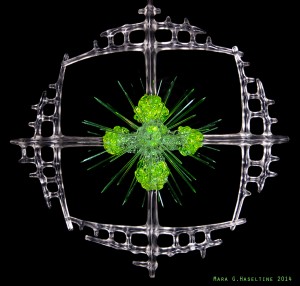
Haseltine hauls her nets back up. She preserves some of the samples to look at later. Back home in a lab, she’ll run the samples through a centrifuge, separating out plankton of different sizes. Today she takes a droplet of Seine water straight to the ship’s microscope. Magnifying the droplet, Haseltine finds a night sky scene––-black background with glowing stars––-until she turns the focus knob and the stars sharpen into white squares, chains, trapezoids: the bodies of plankton.
Unlike the other people working aboard Tara, Haseltine didn’t head back to university and write a science paper about what she saw. Instead, she began a series of human-sized sculptures depicting the tiny plankton, culminating in her two-part series La Boheme: Portrait of Our Oceans in Peril. Haseltine’s sculptures are all saturated colors, the clean curves of the plankton contrasted with the ocean detritus that ensnares them. Almost none of the living creatures in her work have escaped the grasp of plastic waste tossed into the oceans by humans.
Though today Haseltine considers herself a conservationist, she says she grew up in her father’s x-ray crystallography lab. It was the plankton she discovered there that created the greatest sense of wonder in her. “It made me realize the enormity of life as we know it depends on these tiny creatures to provide 50% of our planet’s oxygen.”
Every living creature in the ocean eats plankton or eats something that eats plankton. Even land animals are affected. Plankton feed the tuna in the can in your kitchen. Plankton even show up in your car: the remains of plankton turn into gasoline after sinking to the ocean floor, mixing with the rocks below, and being pulverized for millions of years.
To emphasize the importance of plankton, Haseltine’s sculptures magnify them, making the plankton into objects humans can touch. Her sculptures of tintinnids––a plankton shaped like a vase and about the width of a pencil stroke on paper––stand over six feet tall.
Haseltine began her artwork with images of plankton, but she also researched their life cycles, since some plankton morph their bodies as they grow. In the end, she chose uranium-infused glass to sculpt the plankton so that the finished art will glow when lit by ultraviolet light. She says, “While staying true to the anatomy of the plankton, I imbue the work with my emotion. These creatures are so beautiful, fragile, and resilient I want the world to fall in love with them as I have.”
Next week, I will be at Arisia, the big SF convention in Boston. I’m going to have a table at the art show. Please comment if you’d like to get together.
I won’t be working on any new cameos this year, but I’ll have more knitted bracelets and some gargoyles. And maybe some other things as inspiration strikes and time permits.
damned
test-tube refuse,
love-
lessness grown in tanks and bottles
we stirred fertility en masse
at minimal risk,
same blood, same genes
our co-flesh,
(could we have foreseen
the pillaging and plundering?)
our similarities have become our differences,
same face yet deviant actions—exhibit
the pattern of autoimmune failure.
our soldier selves stand at the front lines.
how many dead?
they hold artificial lives at gunpoint.
triggers assume a life of their own,
becoming thunder claps
and then silence
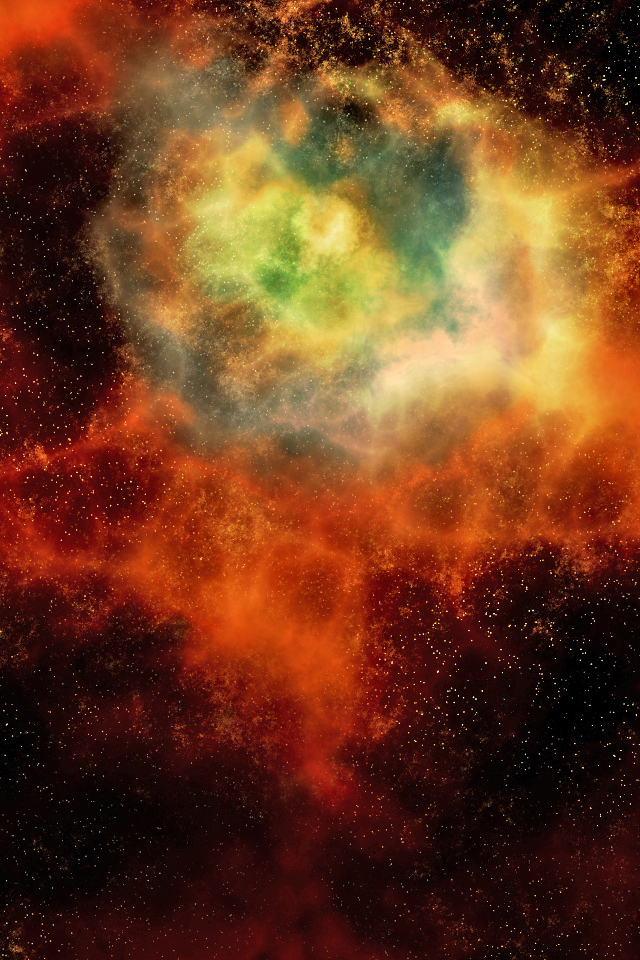
“Nebula2” by Patrick Hoesly – http://www.flickr.com/photos/zooboing/5610784475/. Licensed under CC BY 2.0 via Wikimedia Commons – https://commons.wikimedia.org/wiki/File:Nebula2.jpg#/media/File:Nebula2.jpg
The red of passion isn’t the only fire.
Things burn in different hues,
the varying blues of intensity,
the suspicious yellow nearing outtage
and green, just another element.
Darkness, too, is fire
when love is neither
present or absent.
The chilling heat
chars extremities
with the bitter
you-could-have–
things unsaid always did like
to fester
in meteoric crevices or
black holes or even stars.
Nothing ever burns out
because space never runs out
of refuse.
I miss the Sun But I am alive, Housed in rock homes Inside the premiere Lava tube on the Moon, Carved to be an Underground city.
It’s almost like Living on Earth here, But for the sketchy Sunlight we receive, Depending on the Alignment of the External mirrors.
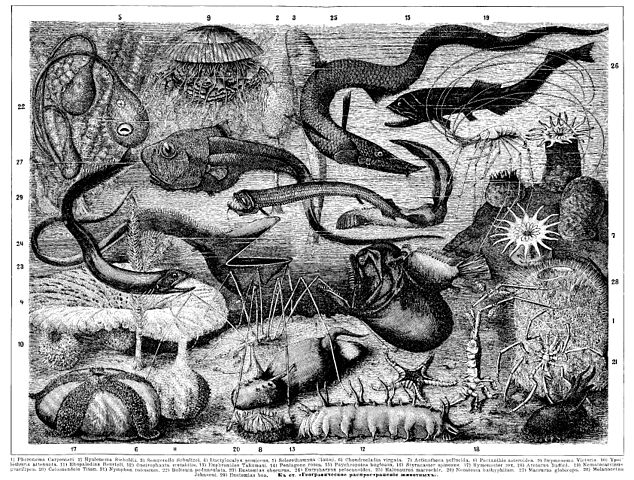
We have twin islands On an artificial ocean, With deep sea creatures Like the anglerfish And the kraken eel, With its stringy meat And relentless stare.
Seaweed thrives, but No fruit or flower has Successfully bloomed here, Despite our scientists’ Best efforts, so we eat What we have to endure And survive.
In the mirror I no longer See me, but a pallid beast With gills and webbed feet. Tonight I will fish In the deep, my luminous Eyes leading the way So my family can feast.
“Burning Ship Fractal”. Licensed under CC BY-SA 3.0 via Wikimedia Commons – https://commons.wikimedia.org/wiki/File:Burning_Ship_Fractal.jpg#/media/File:Burning_Ship_Fractal.jpg
I.
First the storms come
and we do everything
we can to keep the ship afloat,
a three-masted frigate bound
to Portsmouth out of Ceylon ,
riding low in the water with
a heavy cargo of tea and spices.
Dark clouds fill the horizon
and race toward us faster
than the ship can run.
Light flees the sky and
in the false dusk that follows,
a harsh moisture bristling
with electricity fills the air.
Before we can trim the sails
sheets of rain avalanche
down, shafts of lightning
strike the waters about us,
and the wind begins to howl
like a bughouse monster.
Sometimes we manage
to ride out that first storm
and that gives us courage.
Then there is another,
dangerous as the first,
and a third fiercer still.
The masts topple,
the hull is breached,
and we are thrown
into the icy brine
amidst the lashing rain.
As we sink into the cold
and voracious deep,
fish with long rows
of razor-sharp teeth
tear us apart bite of
flesh by bite of flesh.
It seems to take forever
before we can drown,
our mouths screaming
soundlessly as our
convulsing lungs
are filled with water.
II
Worse than the storms
are the deadly calms that
leave the sea motionless,
a sheet of blue glass on
which reflections of the
light above are blinding.
We lie slack upon the decks
in whatever shade we find,
the sun beating down upon
us from a merciless sky.
We wait listlessly for our
rations of water and rum,
our minds lost and vacant
in the unremitting heat.
When the sun finally sinks
to the horizon, we anticipate
the temporary relief of night.
Yet there is to be no night.
Instead of shrinking the light
along the horizon grows.
Glowing orange clouds come
rolling across the waters,
horned clouds filled with
frightening shapes and figures.
The sea begins to boil as sheets
of sizzling lava sweep across it.
The wood of the ship catches
fire and the decks collapse.
As we are cast into the flames,
burning over and again,
the raging fires consuming
us endlessly, our dazed
minds come alive at last,
our pasts parade before us.
Now we realize that we
have never been sailors.
We are investment bankers,
bent politicians, cardsharps
and shady merchants,
rapists and thieves,
outrageous pimps
and audacious whores,
tyrannical husbands
and insidious wives.
All nevermore.
For now we understand
full well for the countless
time that we are nothing
more than unrepentant sinners,
mandatory guests at our own
damnations, sailing upon
the seas of Hell forevermore.
I, Sailko [GFDL (http://www.gnu.org/copyleft/fdl.html) or CC BY-SA 3.0 (http://creativecommons.org/licenses/by-sa/3.0)], via Wikimedia Commons
Old Seer
Don’t you think sometimes
that you got the world weighing down on your shoulders
or that your brightest day
is a little dark?
Don’t let cards or crystal ball get to you like that,
it’s just the fortune tellers’ curse;
learn to live
with the bearblood mark.
Fortune Teller
Sometimes my cards hold water like buckets
left out in the rain,
sometimes I feel their edges singe;
a glass ball is a strange thing,
shards beneath my feet, made whole.
The Tarot Deck
we are not just paint and cardboard, says The Hanged Man
but you’ll have to know us good to know, says The Priestess
Swords chatter their blades, not sure why people would read cards
and The Devil and The Fool sit smiling, back to back.
Old Seer
Before we had words on paper,
we had robes dyed bearblood dark;
people knew what we could do,
and so did we.
Glass Orb
Sometimes, I’d rather be the moon than this,
always clear so she can see through me.
Nobody asks the moon to be glass
and nobody asked me whether I wanted to be just
her crystal ball
The Green Candle
It is funny to watch her pick the truth apart
so she can make a proper fortune of it.
Sometimes, she works true magic, and that’s a different thing;
I’ve never burned so hot
as when there’s magic in my flames.
Fortune Teller
Sometimes I wish I could hide in a bearskin,
the bear’s claws and the bear’s teeth my own.
Why do people come asking for the truth
when it’s the last thing that they want to hear?
Old Seer
Remember that the moon is dark and wild
or starlight bright, yet no more tame.
We are of the moon you and I,
and a grain of moondust is wild in all of us.
Petitioner
I have brought boughs of oak, white ash, and last year’s sage,
incense and a few coins…
I have so many questions!
What say the cards? What is my fortune?
Old Seer
See, when we wore the bearblood robes
all they’d ask us for were proper questions.
These days…
well, you know yourself.
Just make it up
as you go along.
Fortune Teller
I’ll shuffle, and you cut the cards.
Now let’s see what’s in the cards for you:
they are like rivers full of rain
but don’t you worry about that…