poem07 Mar 2011 05:59 pm

Smoke runs down my fingers like morning dew
my ball gown dervish-danced itself to ashes
round my flame-kissed ankles
that long for the axe’s touch
a heat that star-gold shower couldn’t sooth

My lips burn poison with apple kiss
and it is a spark of rose that pricked me into
one thousand years of fiery sleep
and vaporized my sheets with ardent longing

The oven is always hot for those who seek
a trail of crumbs or cinders such as I
and the well is always deep;
it swallows whole my golden fireball

‘What red hair you have!’
and searing heat that changes common desert sand
into quartz glass slippers, with molten tears
I can make your clouded eyes shine bright again

The warm taste of cinnamon wine burns on my tongue
shooting star wings and firefly breath
were my grandmother’s bequest
but the fire from my hands that makes smoke
of all it touches, that alone is mine

the arts and Weird14 Feb 2011 05:57 pm

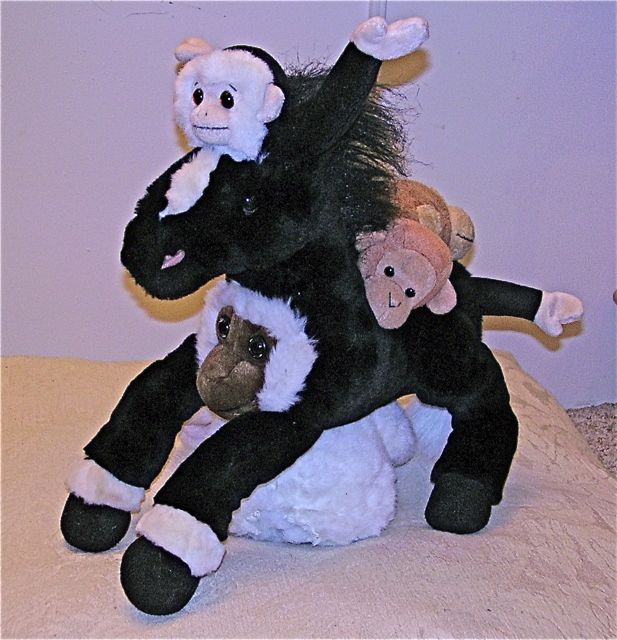
monster inspired by JoCo's Skullcrusher Mountain

Looking for something hugely fun and interactive for a party? Try a Monster Mash — cut up bunches of stuffed animals and recombine them into monsters. Plush fabric is pretty forgiving, so you don’t have to sew well to make your monsters work. Mimi Noyes has been running these for a while for house parties on the west coast and at Norwescon every year. I got to enjoy one at Arisia this year at one of her east coast visits.  She suggests using three stuffed animals per monster on average.  Trying to use more monsters can work, but often just leads to a jumble.  Make sure that you have a lot of variety to start off with, more than just teddy bears and bunnies.  Things with tails and wings and horns are good.  Mimi has set up a livejournal community at http://community.livejournal.com/mashmonsters/ if you’d like to see more of these.  If you have your own Monster Mash party, add it to Mimi’s page so we can all share, and please comment here so we can see it.

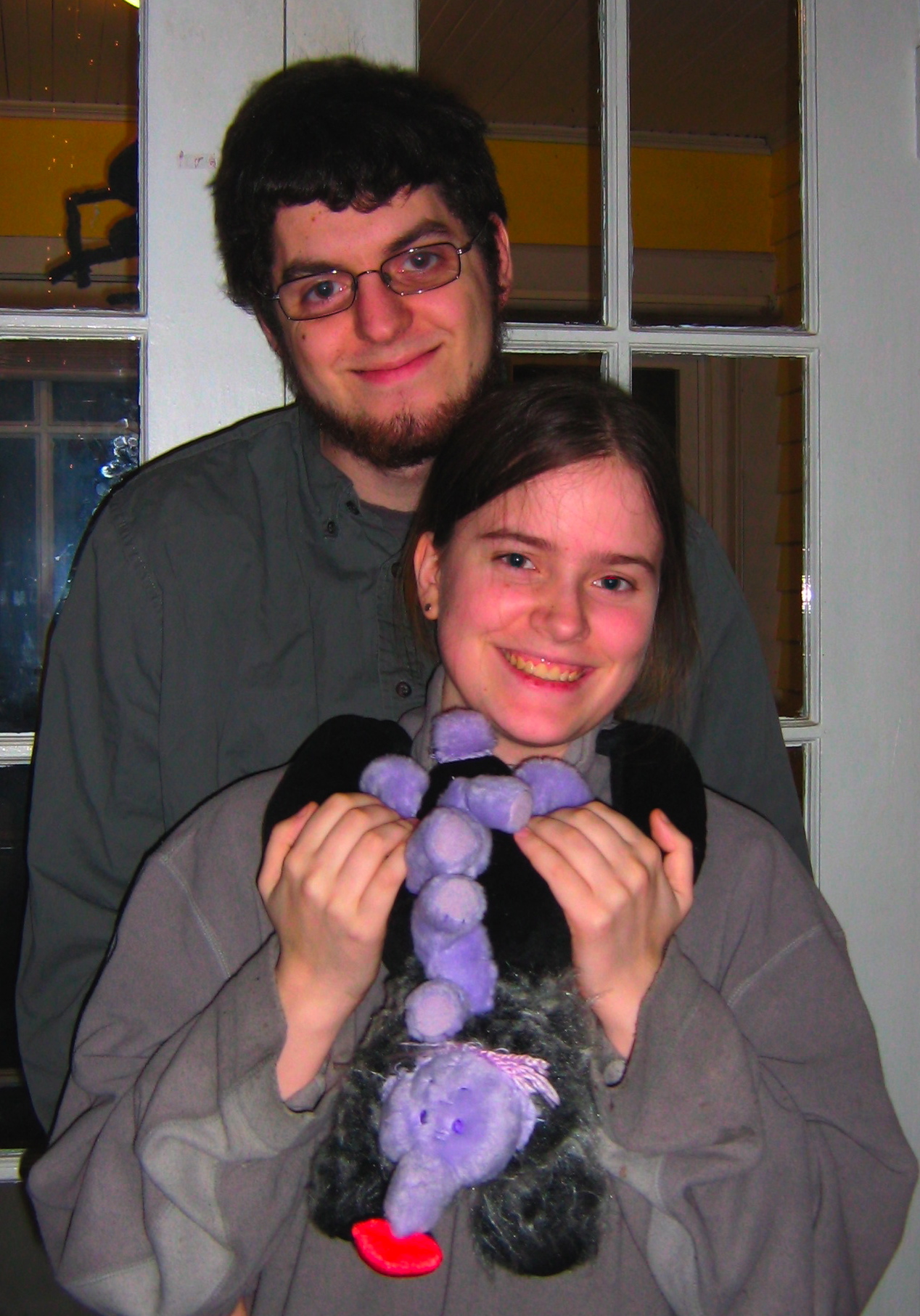
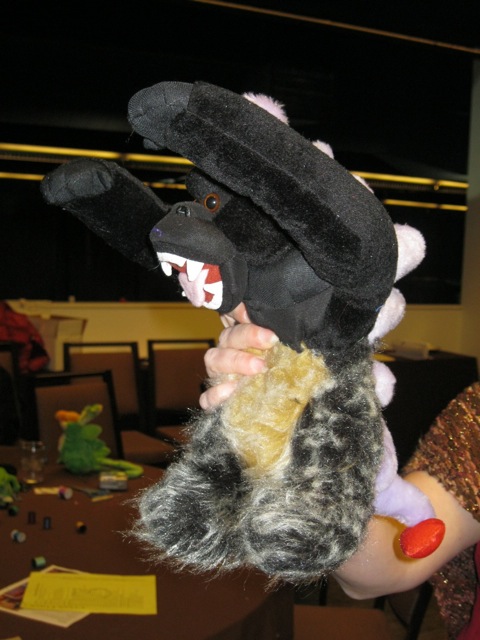
I combined a gorilla, puppy, and elephant to get Loverboy.


In honor of Valentine’s Day and the red heart on the tip of his tail, I show him with the only cute couple around, my daughter Alice and her young man. When I made Loverboy, I was tempted to put the elephant face on the other side to make it obscene, but I showed restraint.

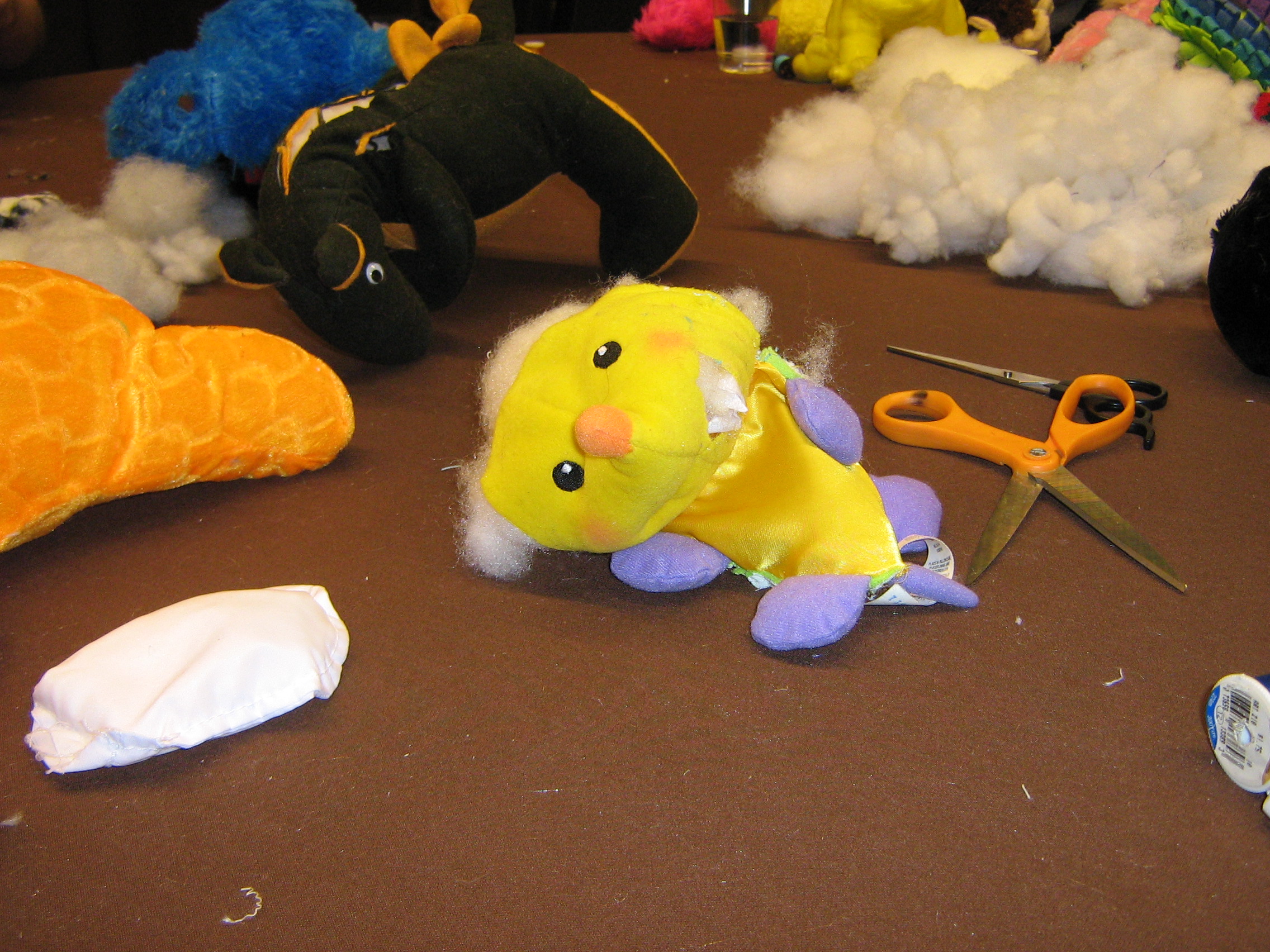
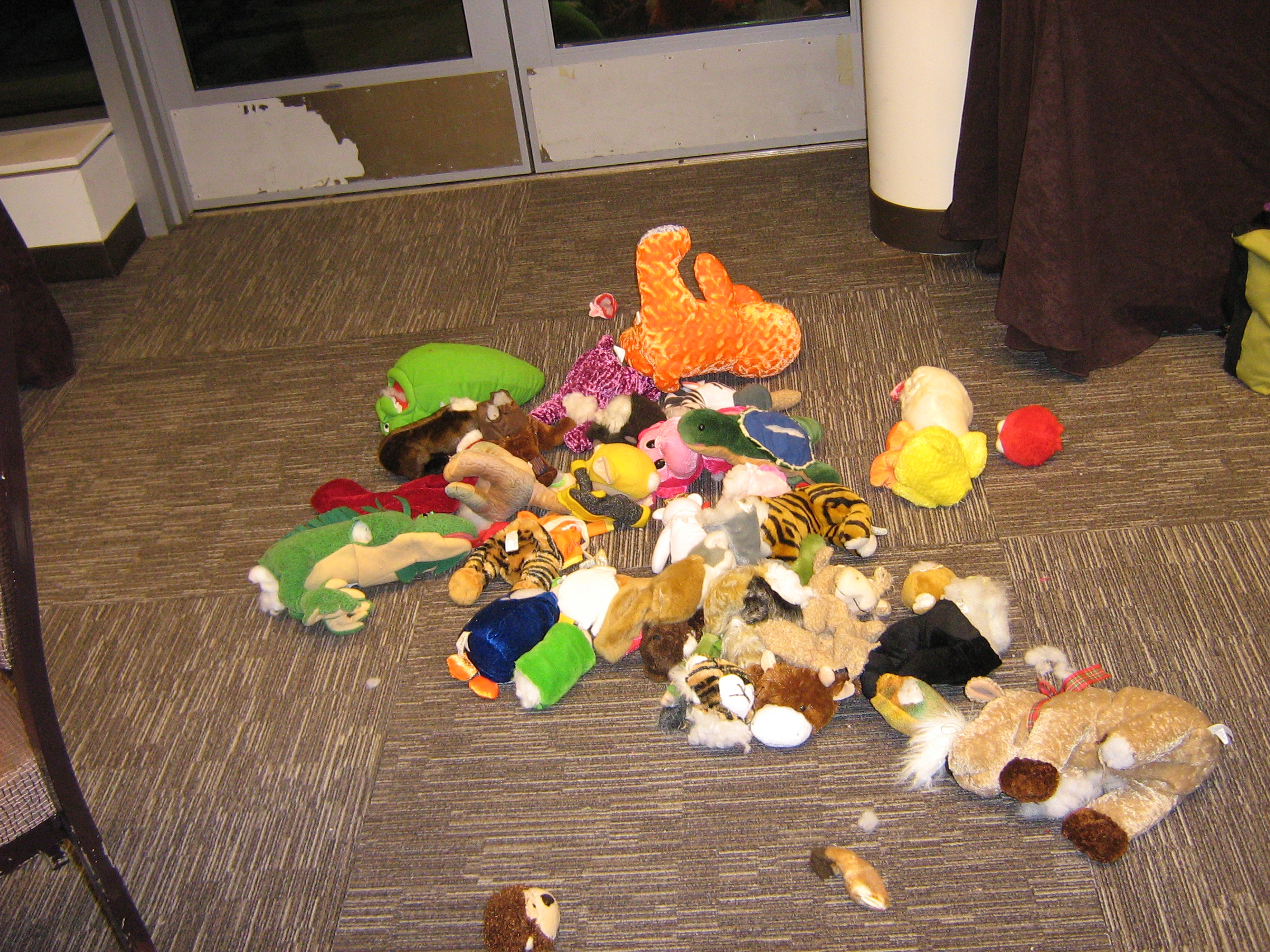
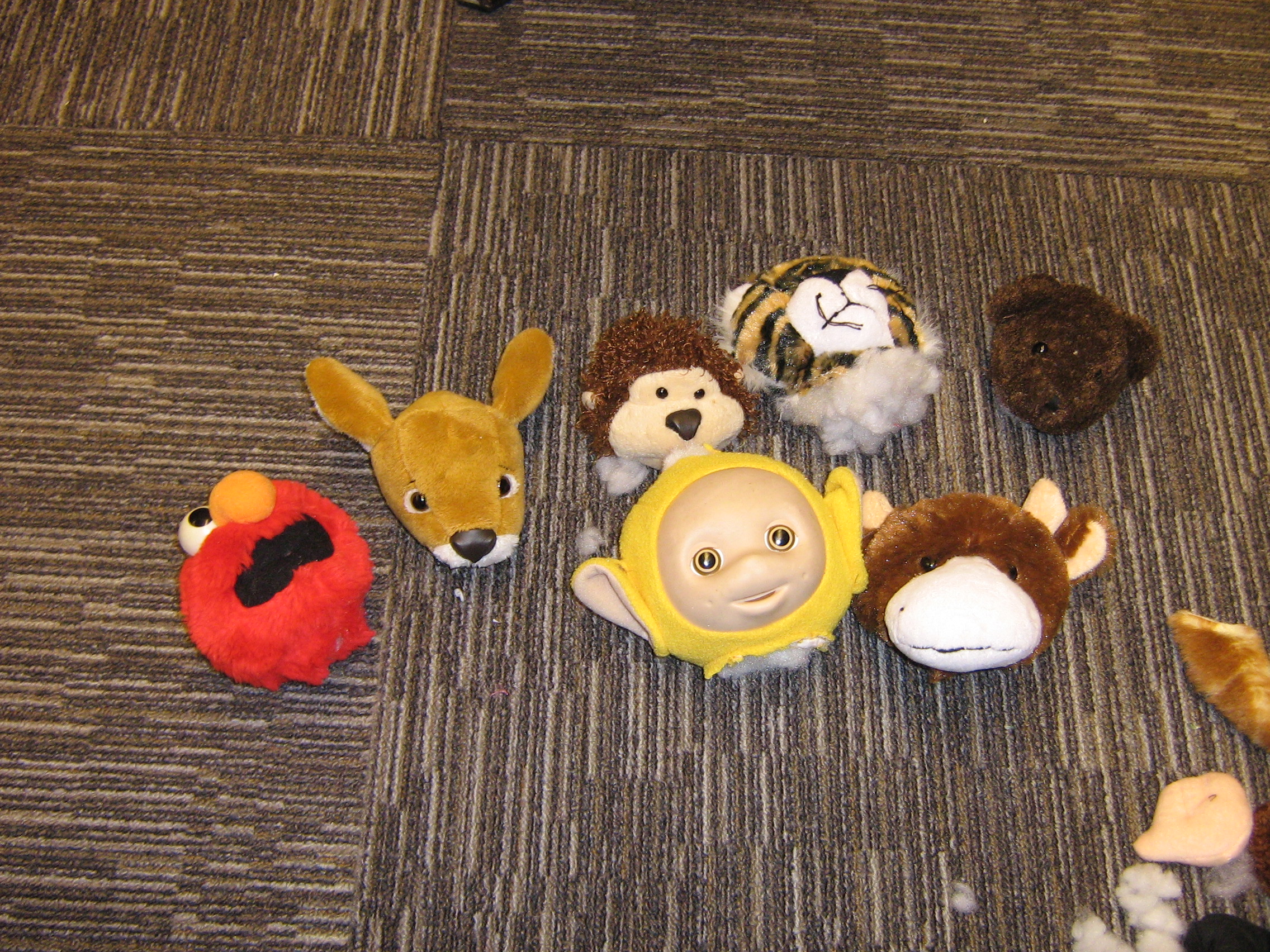
Here are some process photos of the carnage… I’m particularly fond of the decapitated heads.

monster carnage

Works in Progress

Leftover Body Parts

Leftover Body Parts

Monster Heads

Oh my god, the heads....

poem07 Feb 2011 11:18 am

He twists the needle in the doll’s neck
a tiny doll that is made from wool
and my dawn bright hair
it fits his hand just perfectly
although the doll’s painted face
looks nothing like mine

My lips release a scream and pleasure
drops from his eyes
like ripe fruit from a tree
his dark copper skin is slick with moisture
and his teeth are shiny white
behind pink lips

Witch-doctor they call him
but never to his face
to his face, they add a ‘Mr.’ to his name
I gave my hair to him willingly
but even so
he tricked it from me
with false softness
and words much finer than those of any actor
on the stages of this world
he gave me the scissors
and I
cut it off myself

The needle is clean
silvery it shines and looks
as if this doll is the first it pierces
but I doubt it
he is not a young man after all
my skirts crumble against the floor

His hand that holds the needle
pulls back
and I groan involuntarily
he rolls the needle between
his thumb and fingers
storm clouds and forbidden pools
are nothing compared to those eyes
that hold me like a promise
his meaty pink tongue
has a life of its own as it slithers
across his lips

Pensively
his eyes leave me,
look down
and with his needle poised
he considers the doll

Uncategorized31 Jan 2011 11:49 am

Empty Pockets.
Discard jewelry, belts, umbrellas.
Remove shoes, hats, coats, any articles of clothing with sentimental value.
Take off glasses.
Pull out IVs, ventilators, feeding tubes, catheters, implants.
Scrub away tattoos.
Urinate. Defecate. Retch. Shed any remnant of mortal consumption. Wipe hunger from the buds of your tongue, pleasure from the palette.
Forget what seemed to matter, desire, ambition, possession, love, sources of fear.
Close your eyes. Breathe deeply.
Expect a little sting as memory is wiped clean.
Let go of the world.
Step forward.
Behold the nothing of all, void of unencumbrance.
Do not look back.
Pass.

Uncategorized24 Jan 2011 01:30 pm

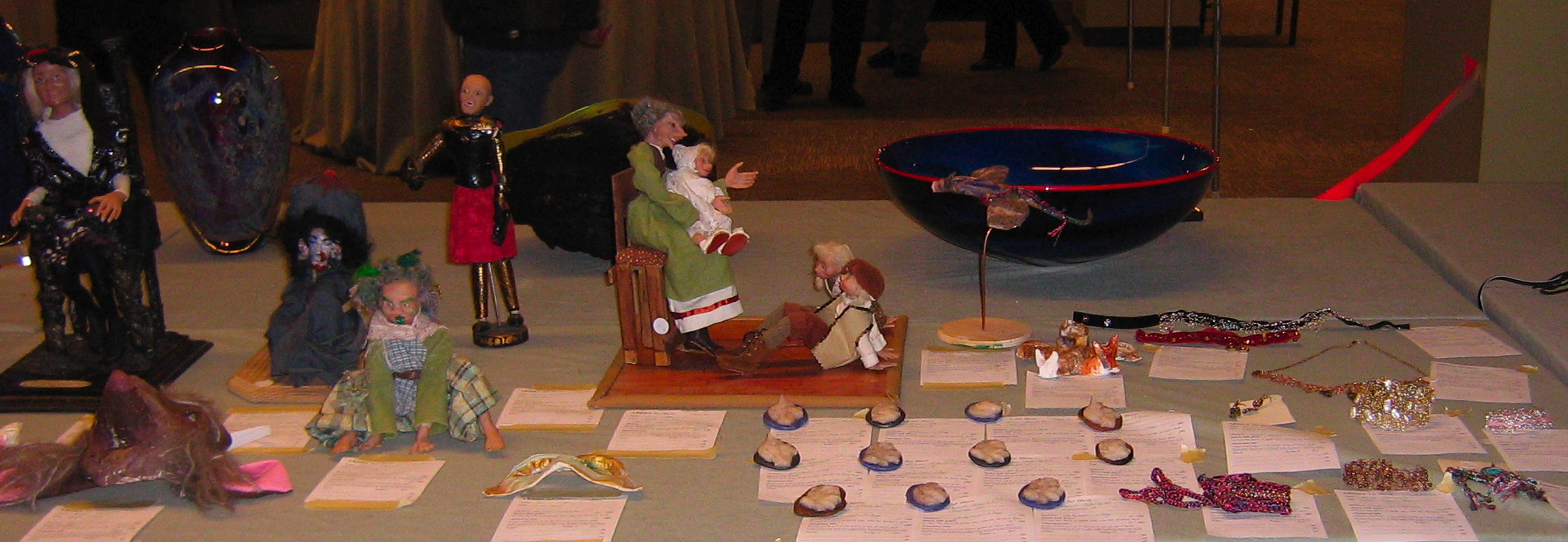
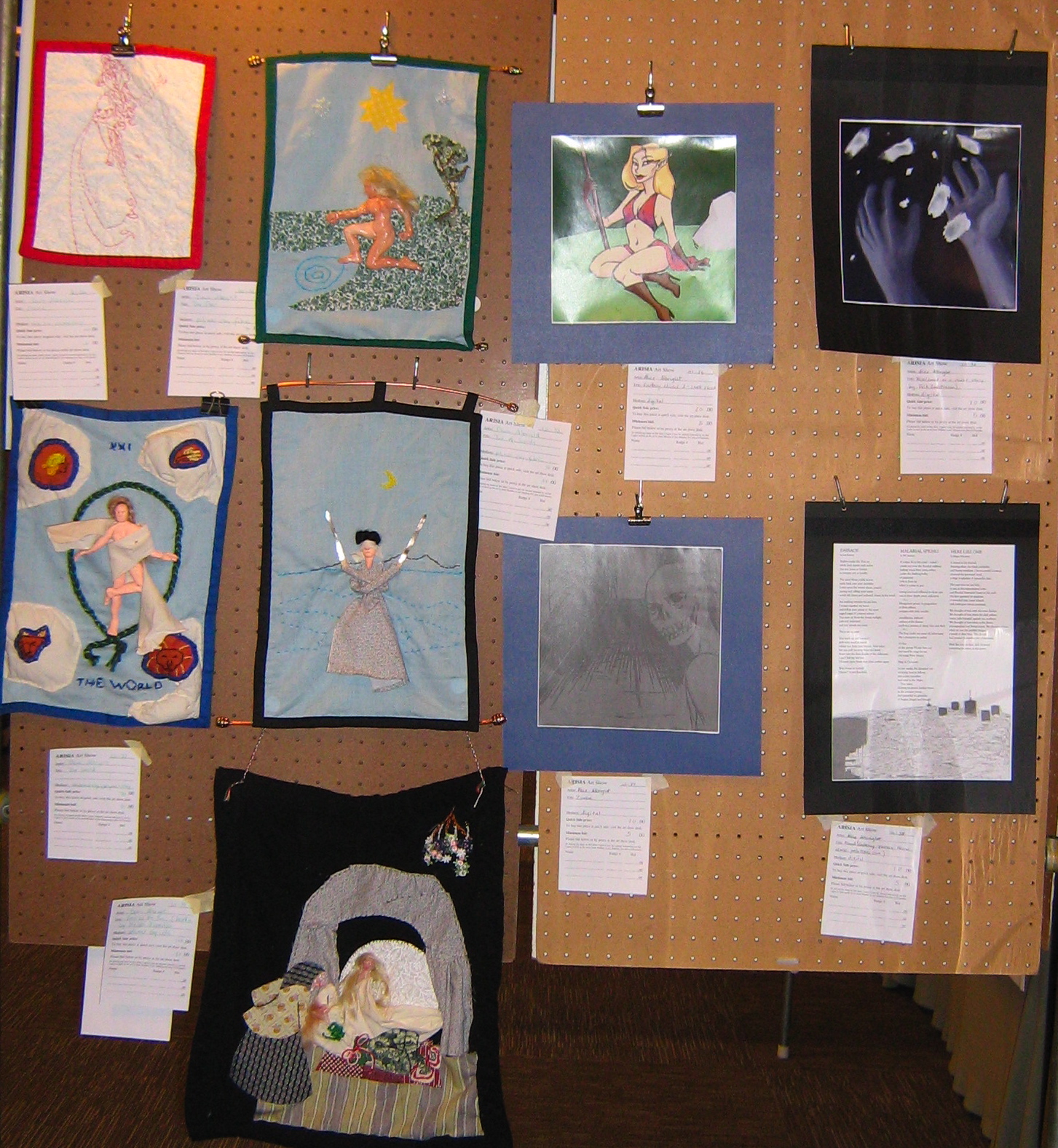
The con was great. I worked my butt off on getting my table ready for the art show, and managed to fill the space. Remind me next time to reserve less space and focus on my best work, OK? Still, I thought my table looked pretty good.

On the table you can see my dolls, some of my jewelry, and the cameos I’ve been playing with lately. On the wall are the mixed media fabric pictures, mostly tarot cards but some classic illustrations as well. On the right you can see my daughter’s pictures, including some that appeared here first. It’s a big hodge podge of different media and styles, but that’s what keeps it fun for me.

editorial10 Jan 2011 12:19 pm

I will be at Arisia in Boston next week. If any readers are interested in getting together, I’d love to meet you. My schedule for the weekend is:

Kamikaze costuming (Fast Track): Sat 9:30 am January 15th
Doll Costuming: Sat 2:00
Play with Clay (Fast Track): Sun 9:30 am
Monster Mash: Sun 3:00
Lies, Damned Lies, and Statistics: Mon 9:30 am
Puppet making workshop (Fast Track): Mon 11:00
Costuming Space: Mon 12:30

The Fast Track panels are for kids. I always enjoy hanging out with children at geeky events. The kids are great, and it’s a good opportunity to meet other parents. Most of my current close friends I have met through my children — it’s one of the great pleasures of having smart, weird, geeky children. Socializing is not my strong point, but it’s always easy to strike up a conversation with someone whose children are busy planning to destroy Tokyo with yours.

The Monster Mash panel is cutting up old stuffed animals and combining them in weird ways to make monsters. I’m looking forward to that so much. It sounds like huge fun.

I will also have space in the art show. I’d love to hear what you think even if we don’t speak at the con. Leave a comment on this post or the next.

fiction03 Jan 2011 04:38 pm

The woman snapped upright from her bent over position.  The hot pie she had just taken out of the oven slipped from the mitts covering her suddenly limp hands.  Slowly she turned…

“Ms. Herron…Ms. Herron…Alexandra, are you all right?”

Alexandra Herron blinked rapidly to erase the nightmarish memory.  Looking up from her desk, she smiled weakly at her secretary. “Yes, I’m fine, Cindy.  Just lost in thought.”

Why can’t I ever forget, she wondered. Why can’t that bitch just die and leave me to my own life?

Continue Reading »

poem27 Dec 2010 04:21 pm

Hugging herself in cinders
That fell from the fire like stars from the sky
Or snow from wintry clouds
And graying her own hair with these ashes
Who can be surprised that they all forgot
Her real name? Was it Agatha or Gladiel
Or Stella or something else? It can be
Surmised that there was a name once at least
Given by a mother and father but then discarded
Like old shoes, unwanted and of no use
Like dead mice and carved pumpkins in November
No one went looking for it either
There was no jeweled slipper that would
Fit this name and anyway, why bother?
She asks herself, when the hearth’s warmth
Is kind and hides her hair and eyes and skin
Under clinging cinders that have a soft touch
Almost as if they care

artist profile20 Dec 2010 06:59 pm

Muliebrity: Noun: Womanhood; the characteristics or qualities of a woman (opp. virility); softness; femininity

After poking around this website for a bit, I think that was my favorite new word. I think it has potential. I can imagine using this is conversation.
Muliebrity MalisonVaticinate
The website is Vagabond Jewelry, the home of Kest Schwartzman, a metalsmith who decided to make very tough simple jewelry because she was tired of not being able to wear jewelry due to the stress she put on it. One of her lines is dedicated to obsolete words that are being removed from the dictionary. These are very simple copper tags with the word inscribed on it. Words like muliebrity, or malison (a curse), or vaticinate (to foretell by prophetic inspiration.) Her thought was that by wearing these words that are threatened with extinction, we can do something to keep them alive. Sort of a preservation program for endangered words. I can get behind trying to save old words, and some of these words are worth using.

the arts13 Dec 2010 03:57 pm

Interactive Fiction – From Art to Entertainment and Back

by Bogi Takács

Interactive fiction, in the broadest sense, includes all fiction with an interactive component. However, the current usage of the concept is much narrower: it usually refers to computer software that is organized around the ‘gameplay’ paradigm but is entirely composed of text. Is there any distinction between these text adventures and interactive fiction (IF) itself? Can IF be an art form? Is the technology behind IF an essential component in the shaping and development of the medium or is it incidental?

Interactivity on paper

Discounting sporadic predecessors, the development of  IF started with nonlinear narratives like Hopscotch by Julio Cortázar or Nabokov’s Pale Fire, both in the 1960s. These early literary experiments failed to start any meaningful trend, even though they were well-received in their own field. The breakthrough came with genre fiction instead: in the 1980s, Choose Your Own Adventure and Fighting Fantasy books where readers could determine the protagonist’s actions in fantasy adventures became massive hits in young demographics. These works were heavily influenced by pen-and-paper roleplaying games, but had advantages over them: they did not require a group of players and an experienced storyteller. The strict second-person perspective these gamebooks used (“You are standing in front of a brick wall”) was different from previous interactive literary works and owed much to these forms of entertainment.

(While Fighting Fantasy and similar print gamebook series mostly died out by the 1990s, the format of choosing from fixed options instead of more open-ended actions still remains. Most contemporary literary hypertext fiction also uses a similar format.)

The text adventure boom and bust

The first text-based adventure games appeared in the second half of the 1970s – they ran on mainframes and were developed by researchers and university students who had access to them. In the early eighties, these people formed companies like Infocom and Adventure International and braved the home computer market. The meteoric rise of the text adventure slightly predated the success of paper-based gamebooks, and these adventures also had a different gameplay mechanism: instead of picking from a handful of possibilities, players were given a prompt describing an environment and the possibility to interact with it by entering verb-noun combinations like “open door”. This was enabled by the use of a parser that interpreted simple natural-language commands.

As technological advances increasingly allowed the use of graphics, first these games began to feature static images and then – with King’s Quest in 1984 – character animation. As fast as it had arrived, interactive fiction soon disappeared from the mainstream of gaming altogether, giving way to graphic adventures.

There is one form of interactive fiction that enjoys continued mass success in the game market: in Japan, a large portion of PC game sales consist of so-called “visual novels”. These works involve mostly static artwork of characters in front of backgrounds (usually both drawn in elaborate manga style), and large amounts of dialogue between the characters with occasional points where the reader can make decisions about the direction of the story. Visual novels are more akin to interactive versions of theatrical works or screenplays than actual nonlinear novels; indeed, some people have adapted plays like A Midsummer Night’s Dream to the visual novel format.

Adventure and art

In the first half of the 1980s, text adventures were massively popular in English-speaking countries. While this success has not been repeated ever since, they still exist, and out of the spotlight, they have gone through a notable transformation: with no commercial pressure, they gravitated away from formulaic fantasy and toward experimentation and artistic aspirations. To be sure, this tendency has always been present: even back in the eighties, science fiction writers authored text adventures (not necessarily making the linear-nonlinear transition successfully!) and there were nonconventional releases, but not to the current extent.

As part of this trend, more and more authors and fans alike began to use “interactive fiction” as the preferred label. Indeed, influential pieces like Galatea by Emily Short, described by the creator as “a conversation with a work of art”, could not be called an “adventure” in any meaningful sense of the term.

The great expansion

While interactive fiction in its present-day form grew out of text-based computer games, the concept of IF can be applied to nonlinear literary works, Japanese-style visual novels, wikifiction (both authorial and crowdsourced) and other forms of hypertext fiction just as well. There is plenty of cross-pollination already: to cite a lesser-known example, Neel Krishnaswami’s Lexicon RPG, a collaborative wikifiction game/project that takes about a month to run, was inspired by The Dictionary of the Khazars by Milorad Pavić; one of the classics of nonlinear literary fiction.

A number of easy-to-use authoring tools also appeared – and continue to appear –, and the Internet allows people to share their creations and to build large databases like the Interactive Fiction Archive, the Interactive Fiction Database and the Ren’Ai Archive (for visual novels). There are regular contests like the Annual Interactive Fiction Competition which also serve to drum up and maintain interest. Thus technology serves as an enabler of interactive fiction – even paper-based forms like gamebooks have made the transition to the Internet, and this has been most fruitful with many fan-made gamebooks appearing that would have had little chance of finding a traditional publisher as the demand for print gamebooks decreased.

Unfortunately, many online fiction venues still shy away from accepting interactive fiction, sometimes for technical reasons, but probably more often due to a general non-awareness of IF’s existence and tradition. The ones that show an interest – like the speculative fiction magazine Ideomancer, which openly solicits for “hyperfiction” in its submissions guidelines –, still do not publish much of this type of material. The reason for this is probably that interactive fiction developers are often not aware such paid venues exist, and thus most often just self-publish online. This gap needs to be filled if we are to see a rise of IF as an art form whose influence reaches beyond its own well-circumscribed group of enthusiasts.

« Previous PageNext Page »