poem19 Mar 2012 06:01 pm

Whatever became of Oberon’s Indian boy,
the one Titania loved so much
she bed a donkey rather than give him up,
then, returning to her senses
seemed not to care at all?

There was no particular talent
he had, no special gift or blessing,
beyond quiet charm and boyish
good looks. There was the unfortunate birth,
the luck of being in the right place,
the right time, catching the scout’s eye
when she felt vulnerable, old, uncertain.

But was he, after all the fuss and fret,
the elemental war of poisoned eyes,
only a lark, a fad, the proverbial
flash in the pan, midlife
infatuation with impossible youth,
something we’d inevitably outgrow?

He became the darling of the internet,
Ganymede without the cups,
aging into oblivion.
He gained a few pounds,
got lost in his own celebrity,
never found love or meaning,
finally died the death no poet
fears, alone and overexposed.


poem12 Mar 2012 05:47 pm

The laying of hands over a warm cup
of capuccino won’t deliver us
from what can be read in this morning’s Sun.

For years our dailies failed to penetrate
even a pulpified body of text
with action verbs and barbed, insightful nouns.

I asked if this wasn’t unusual
and my editor said, “Messenger-gods,
like cloistered monks, can always make amends.”

White lies stain my fingers in the obits
with gilt on paper — photographs, captions,
illuminations cut from the whole cloth,

bound for the cheapest of rags or tabloids
to ward off Times more tasteful than our own.

WC Roberts lives in a mobile home up on Bixby Hill, on land that was once the county dump. The only window looks out on a ragged scarecrow standing in a field of straw and dressed in his own discarded clothes. WC dreams of the desert, of finally getting his first television set, and of ravens. Above all, he writes.

poem05 Mar 2012 05:38 pm

EMERGE RAVENOUS

We are dragons again.
For some years we were men
And dressed our skins with suits.
Hats hid our eyes,
Vests were disguise
For heat of heart—and we were tame.
For a while.

We forgot what hats covered
Our sons were smothered
Not knowing their own fire.
Things will burn now
As they burst out,
As we must.
The dragon does not die.

The drum in our chest beats.
A warrior may retreat
But a blaze
Never loses hunger.
These are wild times again
To be more than men,
Leaving our caves to unshackle these wings.

Bethany is a fiber artist who creates yarn themed on fantasy, cartoon
characters, and book covers. This pursuit inspired the first poem she
published. She lives in Oklahoma for the time being, on a marginally
successful homestead with her family. She blogs about books, writing
woes, and Asian TV at hakusa-tegami.livejournal.com.

Uncategorized02 Mar 2012 05:38 pm

Whew, so this break went on way too long. It was partially due to an overly busy work life and some changes in my schedule that left me without a good weekly time for updates. I have a number of great poems that are going to be going up in the next few weeks, starting with one on Monday. I’m putting a bunch up right now, so I can guarantee weekly updates for the next few months.

author profile13 Jun 2011 05:23 pm

After all the poems I have bought from Polu Texni favorite Alexa Seidel, I wanted to learn more about her. You can read more about her at her blog, http://tigerinthematchstickbox.blogspot.com/ or follow her on Twitter at @Alexa_Seidel

1) Do you consider yourself primarily a fantasist or a poet?
If by fantasist you mean someone who spends way too much time daydreaming, then yes, that’s me. Of course, without all that rampant imagination, I wouldn’t be worth much as a poet. If by fantasist you mean a writer of fantasy, then I’d say I’m both. I started writing stories before I ever wrote poetry because poetry
seemed like something difficult and involved to me, something that I didn’t have the skill to accomplish. At some point, I just gave it a shot, and my first poems were really, totally, devastatingly awful. I decided to see it as a challenge rather than a failure though and just kept on trying. I got better. I got published. I came to love writing poems and the more I did it, the more it became natural and even necessary like breath or sleep. By the way, without inspiration from other poets, I could not have done any of this! A few of my most loved poets, alive and dead, include Yeats, Blake (The Tiger is very possibly one of my all-time favorites), El-Mohtar, Valente. So, to wrap this up, I consider myself a writer of fiction who has become
seriously sidetracked by her lyrical exploits.

Continue Reading »

Uncategorized06 Jun 2011 05:02 pm

She found the words of others in general
to be prayer-dull
even so everyone came to her to speak to her
the devils came, goblins came, gods and demi-gods came,
demons came, mermaids shed their tails and came
in a nutshell
all came, from the cesspool of creation to its finest
and they all gave her words, always words and
nothing but words
no soft meaning, no gentle thought
she found that there is nothing but words to dry the ink on a quill
and nothing but words to dull a freshly sharpened pencil
if only they’d keep their words! she’d think, but they never did
once there came a man
he was just average for a man but
he kept his mouth shut
she was so startled that at first
she forgot to be surprised and just begged him
to come closer like all the others
he did, and when he was close, very close,
he kissed her lips, softly at first, then with desire, feeding her
moisture, gently
their tongues were soon as one and they were shedding clothes
on the floor and took pleasure in one another
It lasted as long as these things do
and when they were still on the floor, close
to one another
he said to her without meeting her eyes: I love you.
she had too, just until he had spoken
as his words spilled from his lips, her desire and passion,
everything she might have given him
vanished like hot breath in winter, like the green from leaves in fall
like the life from someone dying
and she made him go like all the others
after all, somebody else was already waiting to throw words
at her oh so tired ears

the arts23 May 2011 06:51 pm


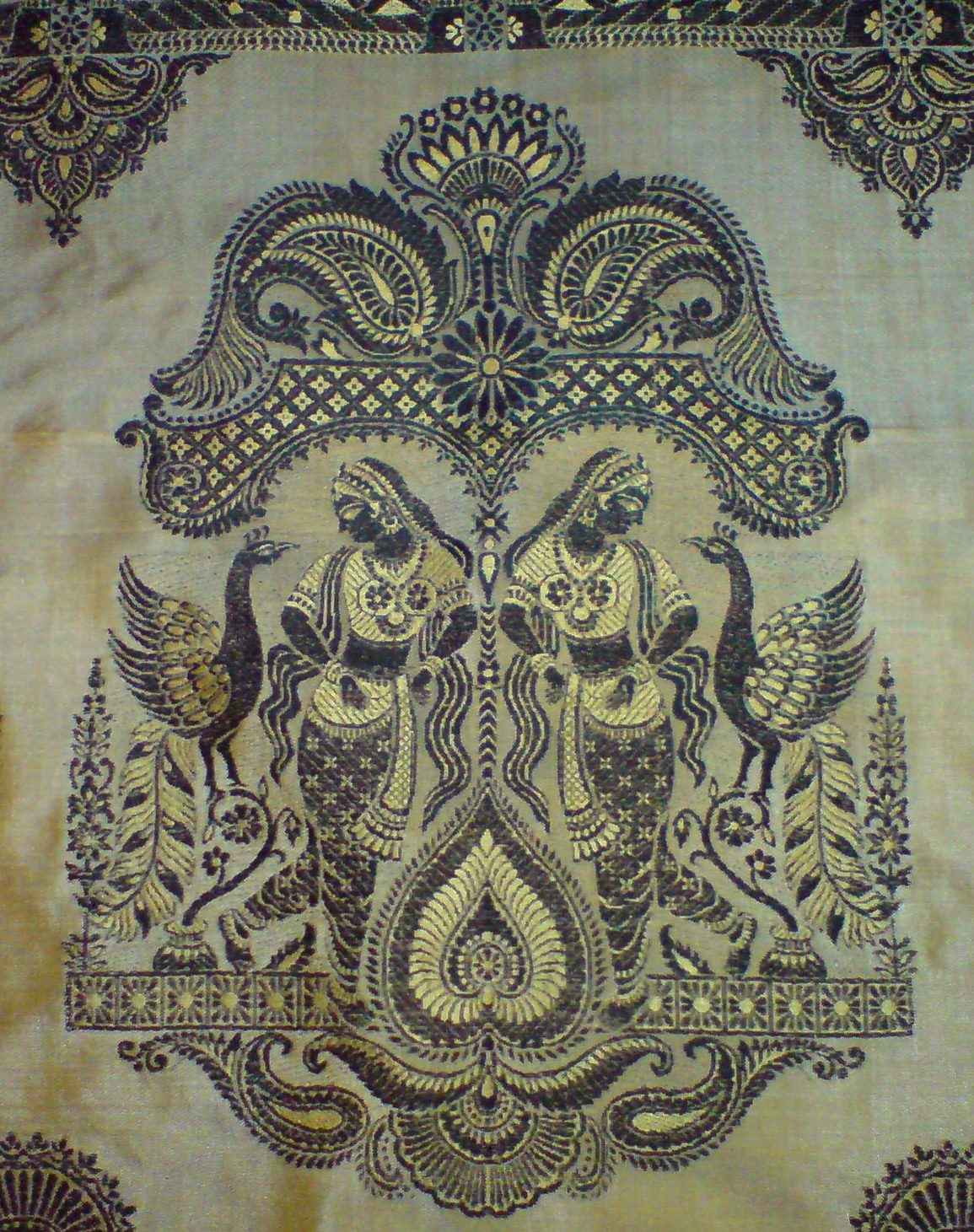
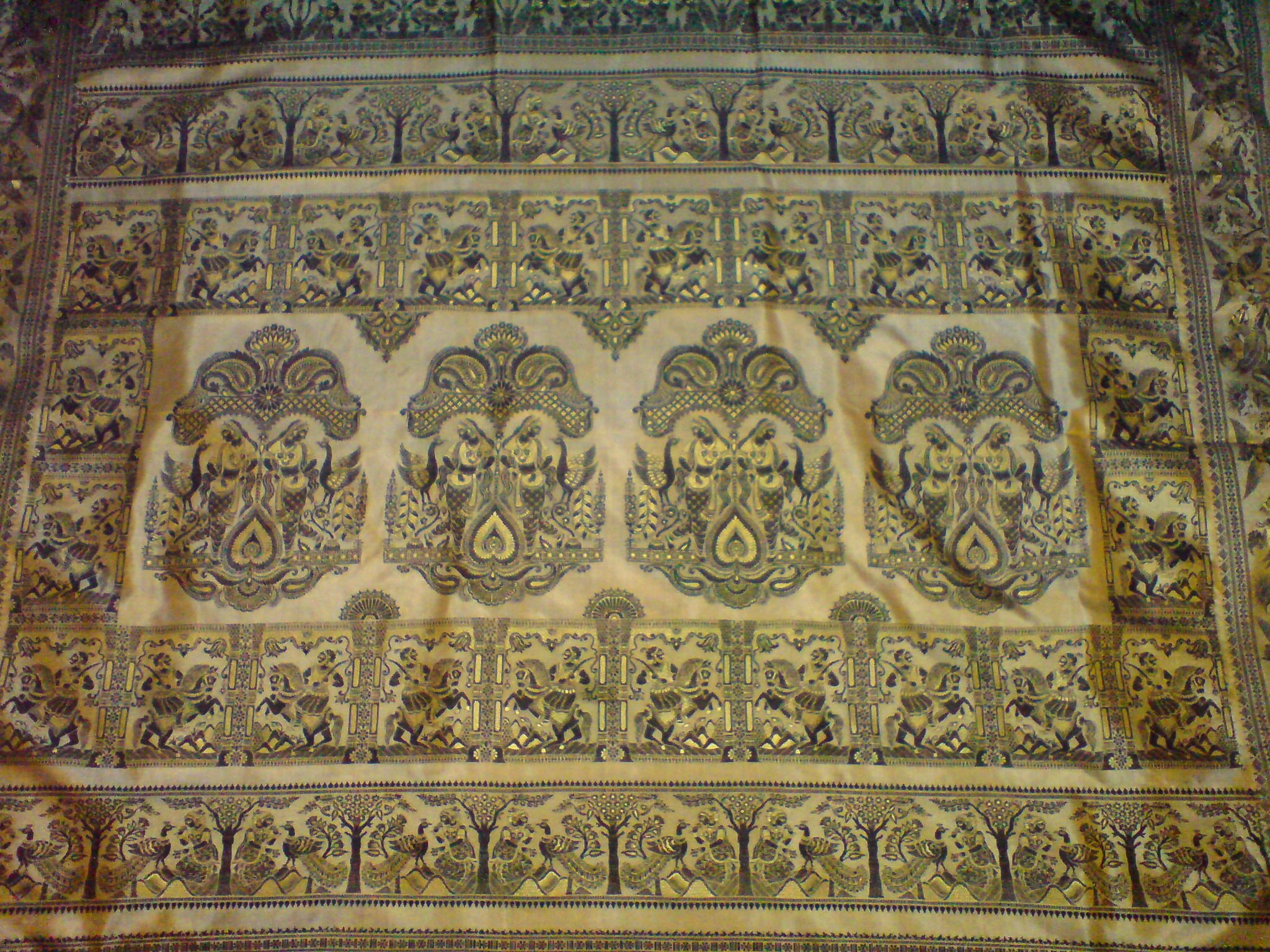
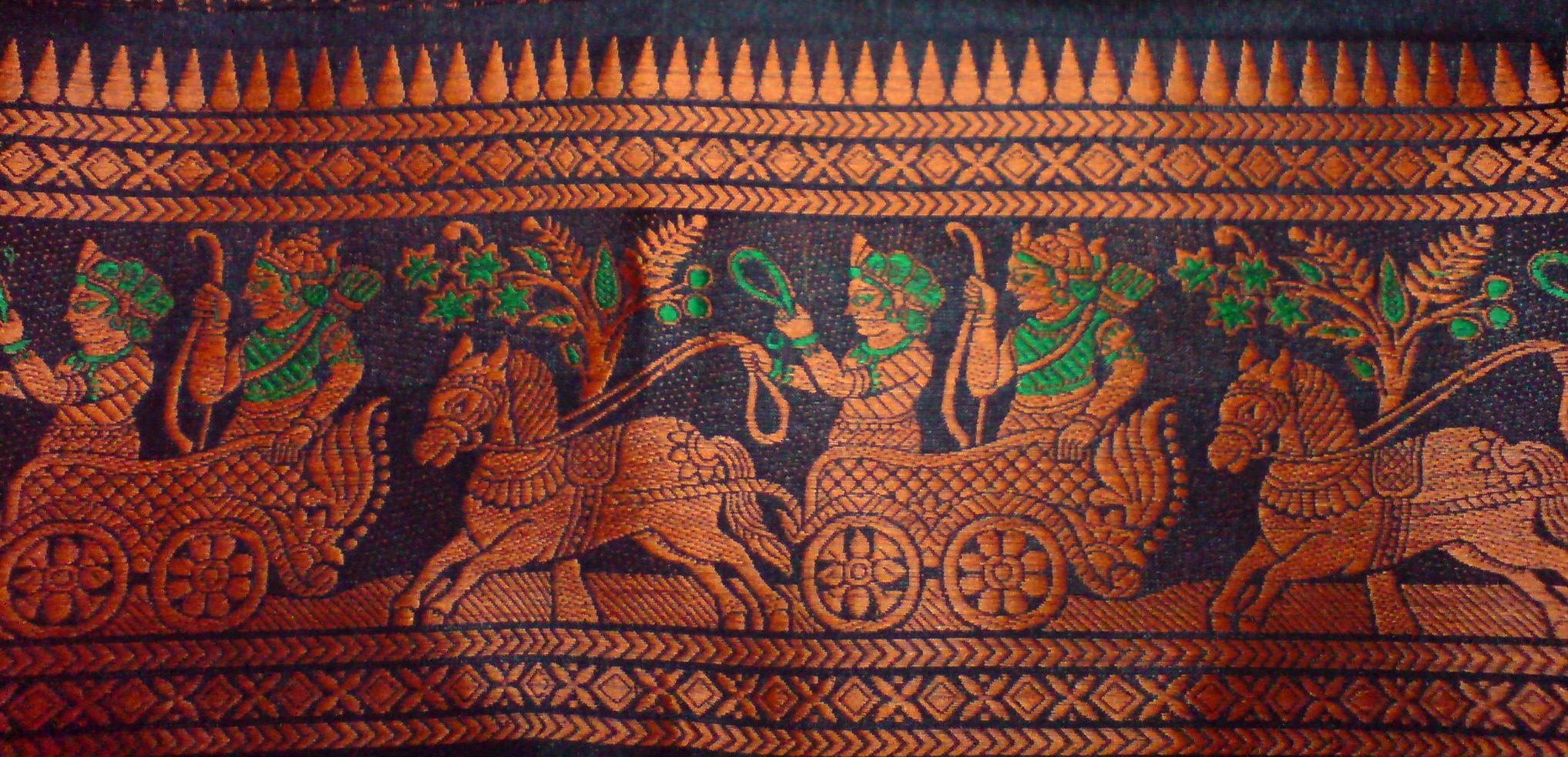
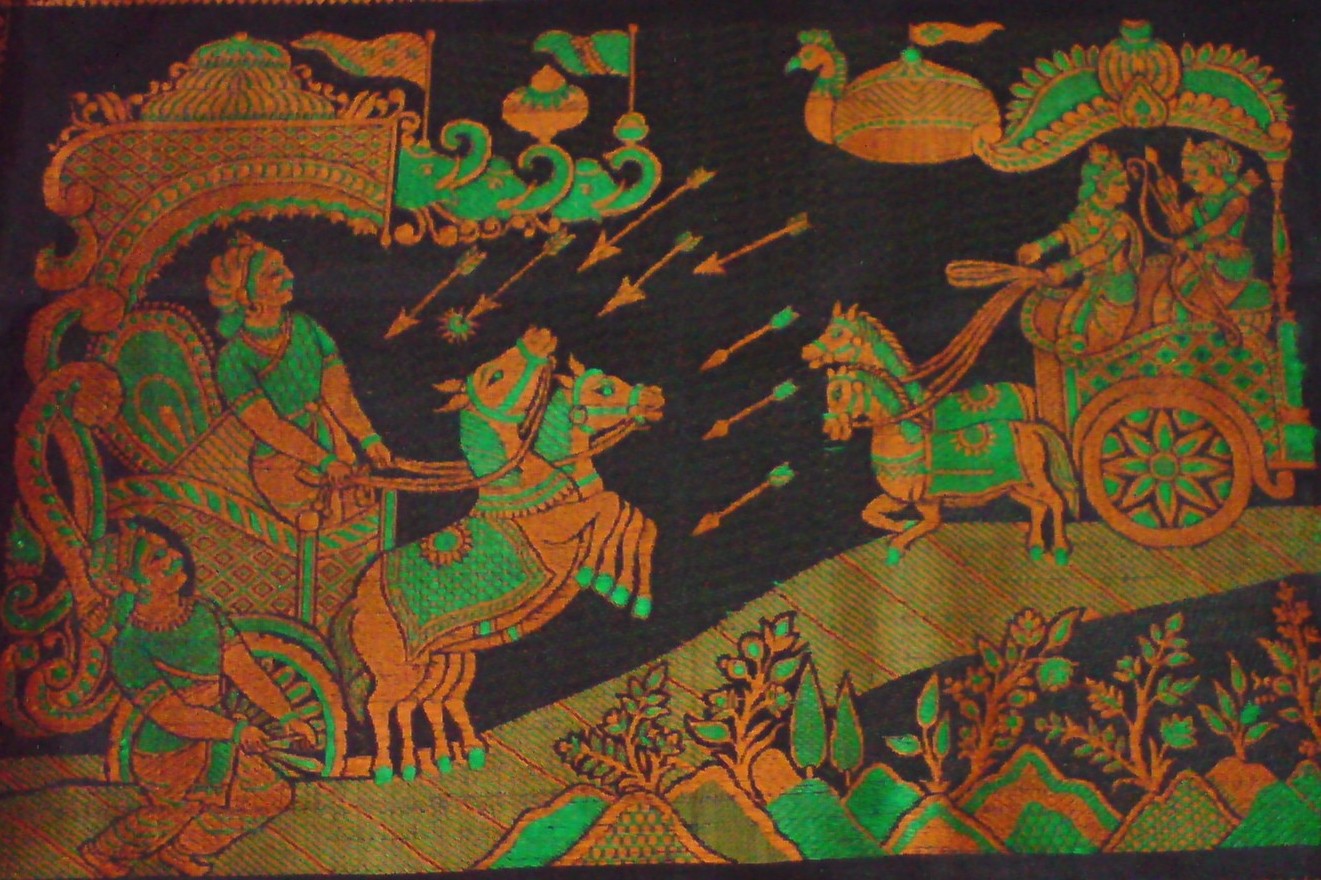
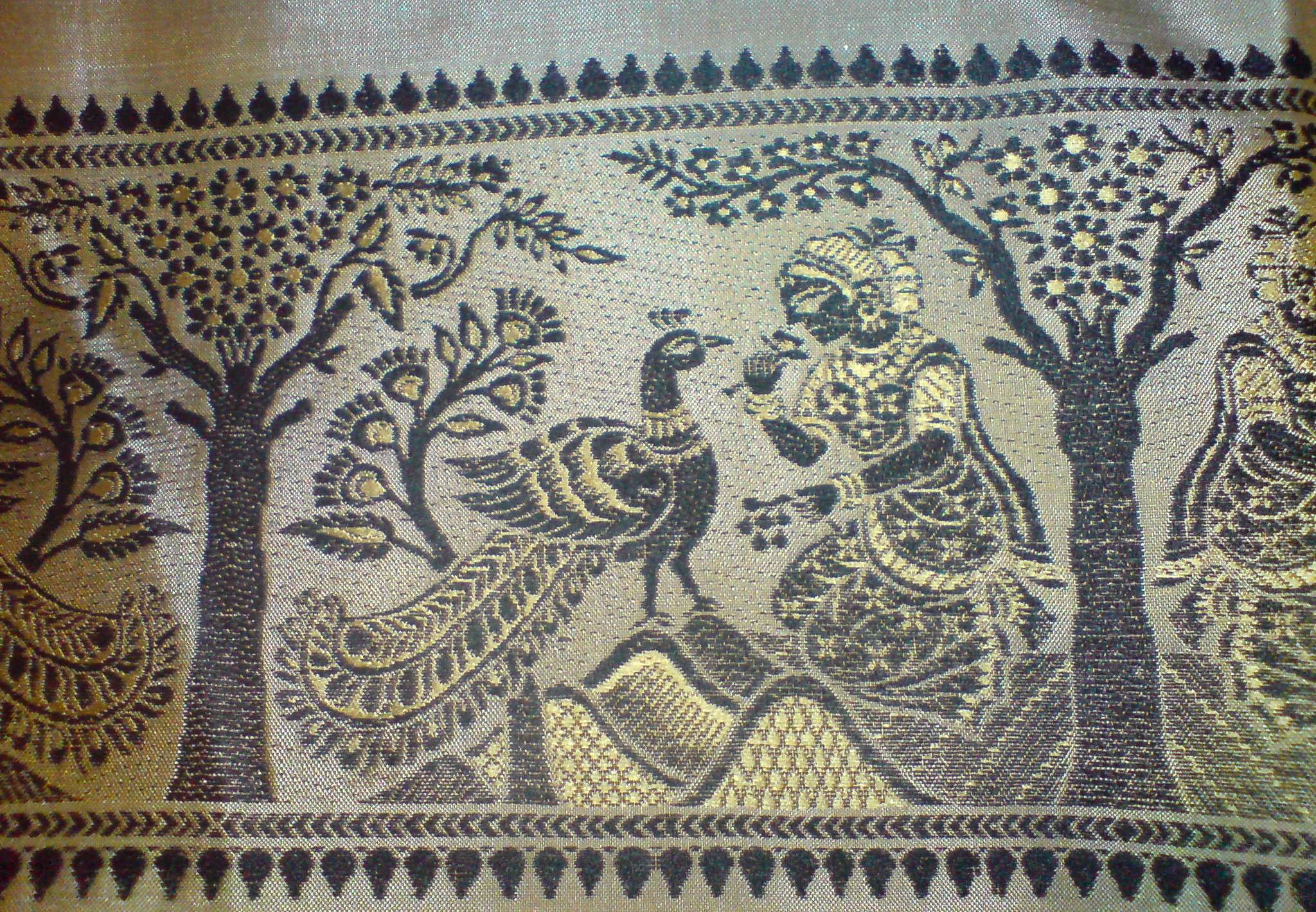
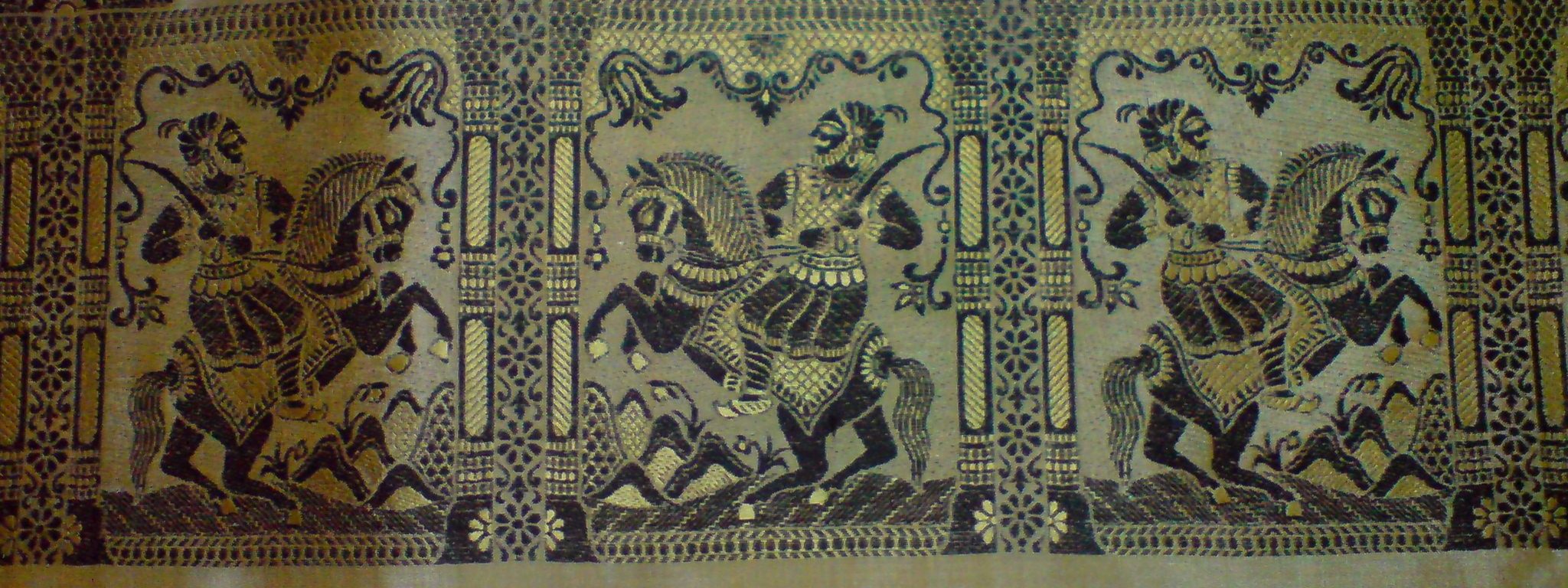
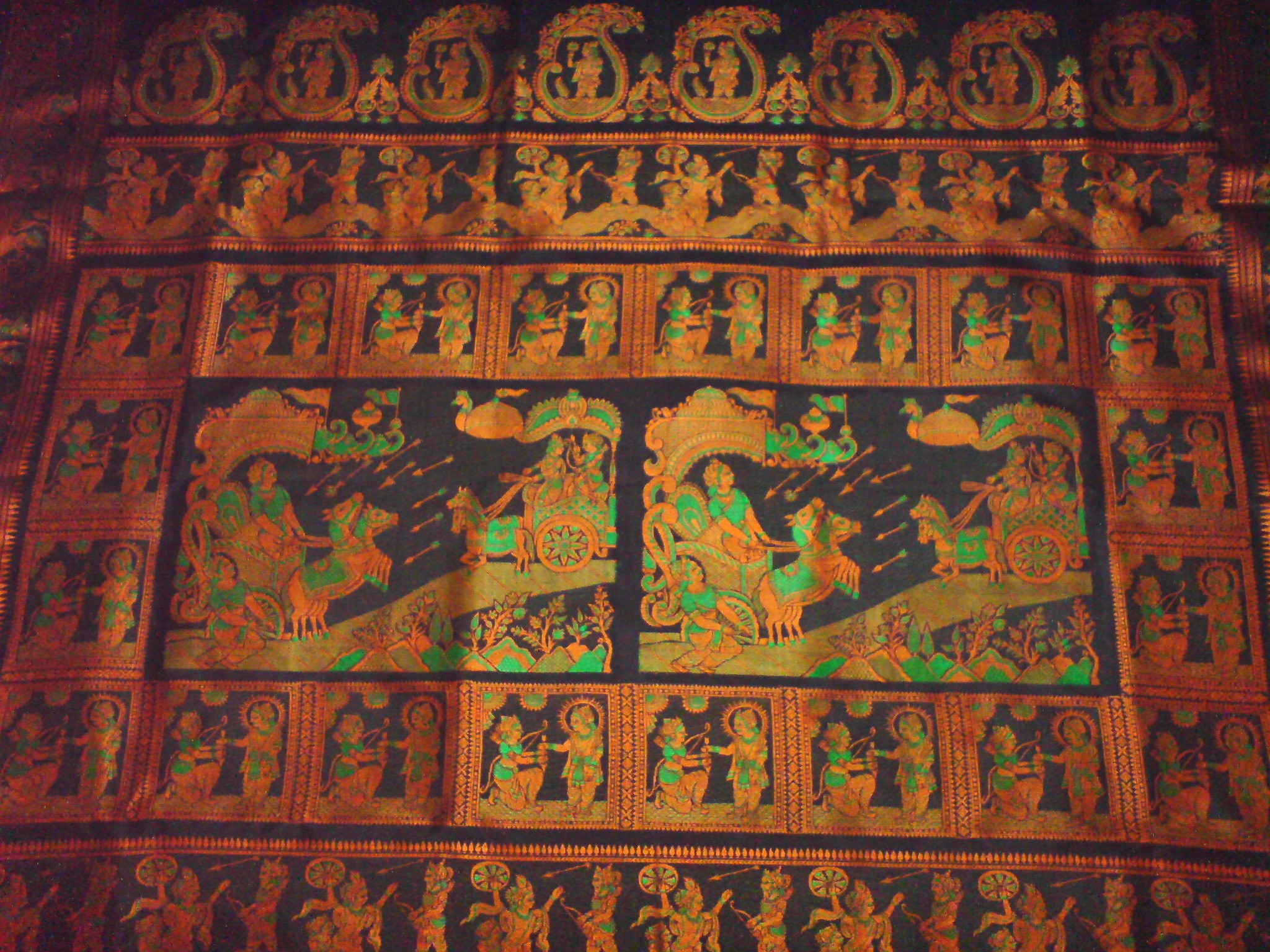
Textile and ancient literature when blended together can create a unique learning experience. The national costume of the Indian woman — the ‘saree’ which dates back to 2800-1800 BC — expresses these sentiments. Every state of India, defines its saree styling with different motifs and patterns based on its cultural influence and habitat. The southern states of India derive their designs from carvings made on temple pillars and archways. One particular eastern style of saree known as the Baluchari specializes in depicting folklore and translates momentous scenes from the epics of Ramayana and Mahabharata.

Baluchari designs are woven in silk and epitomize some of the landmark incidents from the Mahabharata – the confrontation of the armies of Kauravas and Pandavas at the Kurukshetra battlefield, (http://en.wikipedia.org/wiki/Kurukshetra_War ) the agony of Bhishma, the grandsire of the Kauravas and the Pandavas, lying on a bed of arrows. He was so blessed that he could decide the time of his demise from this world. (Introduction of Bhishma http://en.wikipedia.org/wiki/Bhishma ) These epics are the backbone of Indian heritage and there are innumerable soul stirring events that can be encapsulated through weaving and painting. Another favorite scene is the depiction of Lord Krishna driving the chariot of Arjun, taking him to the center of the battlefield and narrating to him the essence of Srimad Bhagavad Gita. (Srimad Bhagavad Gita http://en.wikipedia.org/wiki/Bhagavad_Gita ) There are lessons to be learned from these patterns which many are ignorant of. We can only narrate a fraction of the meaning of these motifs because these epics were written with a purpose and are transcendental in nature.

Scenes from the Ramayana are elaborate and distinct where the most common backdrops are the exile of Lord Rama, his wife Sita and his brother, Lord Laxmana from their kingdom of Ayodhya and their meeting with the Simian God, Lord Hanuman. (A short narration on Lord Hanuman http://www.hinduism.co.za/hanuman.htm ) The great devotee that he is, Lord Hanuman is always depicted bowing with humility at their feet. He plays an instrumental role in locating Goddess Sita when she was abducted by demon king Ravana and finding the right herb Sanjivani, to save the life of Lord Laxmana.

Lord Hanuman is often portrayed in a flying stance, carrying a mountain on his hand. The legend behind this is when Lord Laxmana was wounded in a battle with Ravana, he was critical. The only way he could survive was if he was given a special herb. Lord Hanuman volunteered to find this potential remedy and flew to the Dunagiri mountain. Amongst a variety of vegetation, he was unsure of which the right one was and as time was running out, he lifted the whole mountain and rushed back.

Besides illustrating epics, Baluchari saree borders are weaved with symbolical designs like conch shell, lotus, wheel, bow and arrow. Lord Vishnu, the god of preservation is always depicted with a conch in his hand. The conch is played in several auspicious ceremonies and its resonance emits positive vibrations. It provides a welcoming atmosphere for the deities to partake in the rituals. The battle of Kurukshetra too began when the conch was sounded at dawn and ended for the day, when the conch was sounded again at sunset.

The lotus flower denotes the presence of Goddess Laxmi, the goddess of fortune. Lord Brahma, the creator of the universe and the goddess are depicted seated on a lotus. The lotus-eyed one is another name of Lord Vishnu. The lotus has a lot of significance associated with the chakras of the human body as well.


The bow and arrow depicted in motifs extends its significance with the great archer Arjun from Mahabharata.

The wheel motif has several interpretations. Some wheels depict epochs while others signify the chariot wheels that Lord Krishna drove and took Arjun to the core of the battlefield. Some wheels explain the various battle strategies and formations that were used to outmaneuver the enemy during the Kurukshetra war.

Kantha saree is another style of saree from eastern India that translates literature in art form. This stitch is used to describe folklores and the most popular among them is the story of Behula and her husband Lakhinder. Once Lakhinder’s father had offended Goddess Manasa and she taught him a lesson by sending a snake to bite his son on his wedding night. In those times, it was believed that a person deceased from a snakebite was still alive and could be revived by a resourceful snake-charmer. So the body was set afloat on a boat and allowed to wander across the river. Behula decided to remain next to her deceased husband’s body and sailed across the ocean. After a lot of hardships and angst, she managed to appease the goddess who then by her benediction brought Lakhinder back to life. (Behula Lakhinder Folklore in detail http://www.pantheon.org/articles/m/manasa.html )

The widely used Kantha motifs are solar motifs depicting the power of the sun and energy from fire, the swastika which depicts a sign of good fortune, the tree of life that expresses fertility and abundance while the “Kalka” represents a mango leaf which is sometimes also stylized as flames. Mango leaves are considered auspicious in most Vedic rituals. Kantha patterns are embroidered on bedspreads, handbags, cushion covers, tablemats and so on. They can be mounted on frames and can be used as exquisite wall hangings.

Folklores are still existent and we can give some of the credit to the workmanship of the artisans who entice their audience with vibrant embroidery threads and paint true to life colors that beckons us to take a journey back in time. Art and its various forms can be best appreciated with the comprehension of literature.

You can find more about Nayanna Chakrbaty’s work at http://www.original-writer.com/

Uncategorized03 Apr 2011 05:45 pm

She had never been a good wife
staying out till all hours
coming home wet and wild
with flesh stuck between her teeth

She had fallen for his best lines
reeled him in, netted a husband
After marriage she dropped the camouflage
became a bit of a disappointment

When she joined the band she found her place
forgot for awhile who she was
rattling spoons over her scales
and singing of shipwrecked loves

She stopped looking at other men
remained mute upon the rocks
traded her shell bras for ones of lace
sailors watching still ran aground

Perhaps she needs to try again, harder
loving words are bait enough
but pearls last longer when held in the hand
her husband but a shoal against the sea’s allure

She had tried to be a good wife cooking
calmly stirring the bowl’s contents
but she couldn’t help dip the spoon and lick it
add pepper to fish heads and fingers

Not all sirens give warnings but she will
write a note on handmade, scented paper
will not eat her love but leave him
with fishwife memories when the ocean calls

poem27 Mar 2011 05:33 pm

After the Rapture we were mostly unchanged
except for the souls cut away from our flesh
like excised organs, which left bloody pockets
to probe with mute sorrow
over and over,
not quite believing,
forever unfeeling.

After the Rapture our tongues were the same
yet food lost its savor, we munched like cattle
on whatever we found, (no gourmands left
at the end of the world);
we drooled tears and remembered
the hot tang of pepper,
the apple’s bright crunch.

After the Rapture our eyes still remained
to behold the twilight and ruin, yet colors
bled; the world became a city
beneath gray umbrellas, soaking
and dull, resentful of sunlight
and its remembrance of warmth.

After the Rapture our limbs were retained
except that we moved absent grace—
puppets of meat which fretted and jerked
and drooped at day’s end.
Our feet were struck dumb;
if we moved at all it was to crawl
as though groping through darkness.

After the Rapture our loins still flamed
in aching flesh; yet we grew soft, made love only
to pass the time. Every release affirmed
our jagged isolation; a tragedy of trysting limbs,
each little death a memento
of that brightness carried away.

After the Rapture our gods were exclaimed
by the madmen who arose like mushrooms
after the rain, flagellants and penitents,
crawlers and kneelers and squealers
who cried out in the night
and rent their skin to suffer
the ecstasy of sensation. They didn’t.

After the Rapture our peoples were changed
and came to prefer it that way. Churches all closed
and were left to the bats. We moved slowly
together, masses of flesh
grown rusty as war, nodded to sleep
beneath placid skies; untroubled except
for our satellites falling to earth.

poem14 Mar 2011 06:18 pm

Of course there were warning signs:

slammed doors, the silence at breakfast,
arguments over who should get the paper
or let out the dog. Things moved

or disappeared;
the sleeping pills changed cabinets,
his favorite books left gaps
like skull’s eyes in the shelves, and though

he always had an answer for you, still
still,
you might have seen and known

and turned…where?
What magic brew could draw
poison from a poisoned heart,
could harden his skin against himself?
Whose name would bind him,
what enchanted key could open
the rusted locks behind his eyes?

Fate is a muddy track
that hardens around our footprints.
All its signs are
backwards, written in a glass.
Fate is the worm in the apple,
hidden until the first bite.

And none of this can help you,
nothing can change what your heart
refuses to disbelieve:
that this was not his path.
That all the fault is
yours is
yours is
yours.

« Previous PageNext Page »